


Quick Assessment
Step 1Answer a few questions to help us understand your current situation.
The process doesn’t have to feel complicated. Follow three simple steps with professional guidance along the way.
Answer a few questions to help us understand your current situation.
Attend a 1 on 1 consultation with a licensed mental health professional to see if you qualify.
Receive your ESA letter within 24-48 hours of approval.
If you’ve never dealt with an ESA before, it’s completely understandable to have questions. An Emotional Support Animal letter is documentation from a licensed mental health professional that may support a person’s need for an emotional support animal.
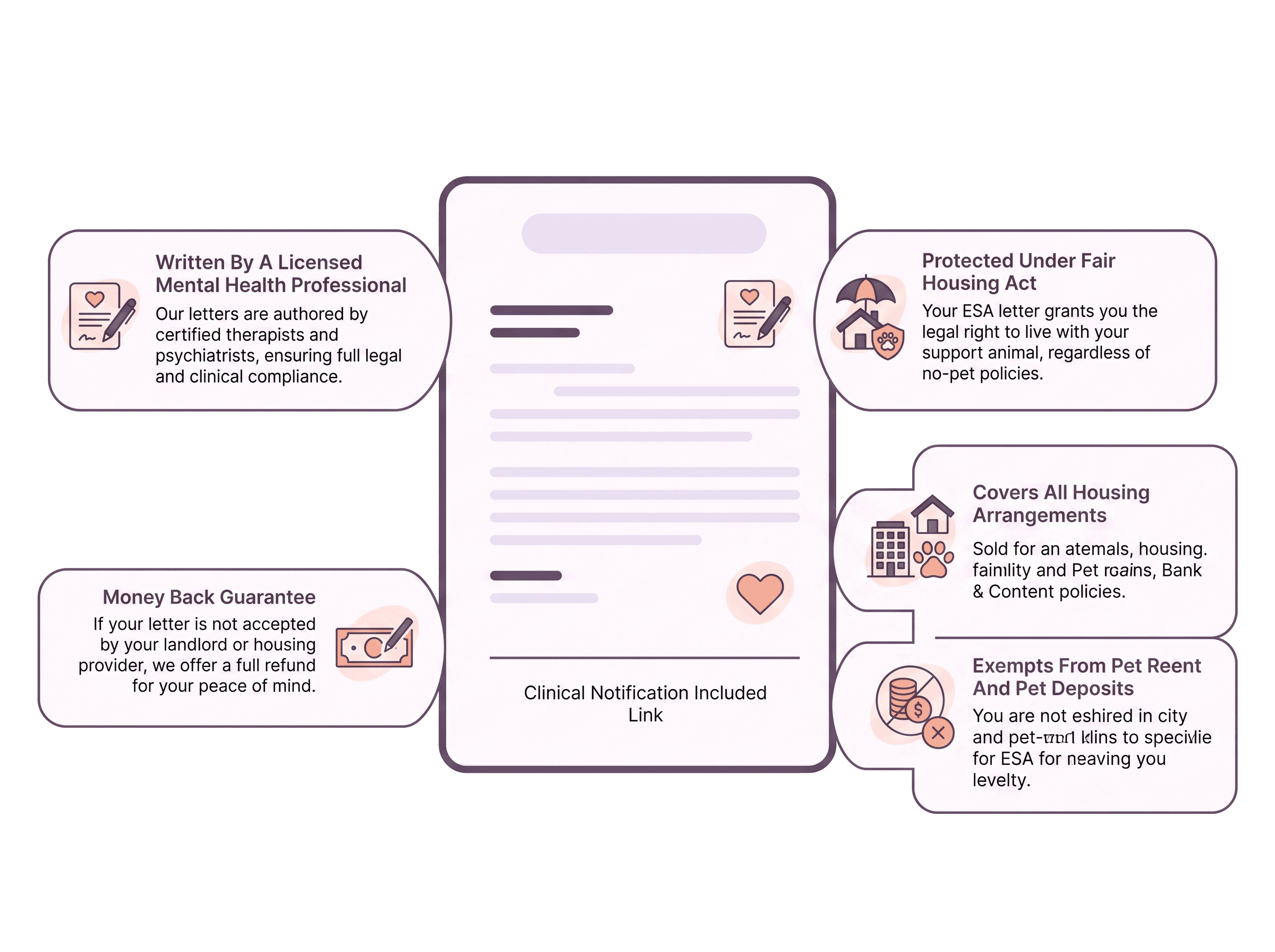
It’s documentation from a licensed mental health professional that may support a person’s need for an emotional support animal.
When clinically appropriate, it recognizes your animal as part of your emotional wellbeing rather than just a pet.
An ESA is different from a service animal, which is individually trained to perform specific tasks related to a disability.
Turn each card over for a concise explanation. Hover with a mouse, or use tap, Enter or Space.
If you have any questions, our support team is here to guide you.
| Emotional Support Animal | Service Animal | |
|---|---|---|
| Legal Framework | Fair Housing Act (FHA) | Americans with Disabilities Act (ADA) |
| Species | Any animal (dogs, cats, birds, etc.) | Dogs only (miniature horses in limited cases) |
| Training required | No specific training required | Must be individually trained to perform a specific disability-related task |
| Documentation | ESA letter from licensed mental health professional | None required for housing. Airlines require self-attestation. |
| Housing access | Yes — landlords must provide reasonable accommodation | Yes (covered under FHA) |
| Public access | No — not permitted in restaurants, stores, etc. | Yes — full public access rights |
| Air travel | No longer protected under ACAA (as of 2021) | Yes — must be accommodated in cabin |
| Qualifying condition | Mental/emotional disability (anxiety, depression, PTSD, etc.) | Any physical or mental disability with a task-specific need |
| Valid In All 50 States | Yes | Yes |
| Learn More | Learn More |
Do I qualify?
If you live with any of these — and your pet helps you cope — you may qualify. A licensed clinician makes the final call, and most people find out within a day.
An ESA is a companion animal that provides therapeutic benefit for a mental or emotional condition. Unlike service animals, ESAs need no special training — and with a valid letter, they're protected in housing under the Fair Housing Act.
Read the full ESA guide →Free to start · refund if you don't qualify

Explore state-by-state information about Emotional Support Animal laws, housing protections, and important local considerations.

Choosing support is personal. We believe the process should feel respectful, transparent, and human from the moment you arrive.
Connect with qualified mental health professionals who take the time to understand your situation.
Your personal information is handled with care and respect.
No confusing promises or unnecessary pressure — just straightforward information about your options.
You don’t have to navigate the process by yourself.
Anonymized, paraphrased experiences shared publicly by people navigating pet housing.

“Speaking with a licensed professional made the process feel legitimate, clear, and much less intimidating.”

“Knowing I could update my housing request later took one urgent task off my plate when I was already overwhelmed.”

“My landlord accepted the documentation without extra back-and-forth, which gave me real peace of mind.”

“The clearest guidance was learning that there is no ESA registry—the professional letter is what matters.”
Compare ESA and PSD options clearly. A licensed provider makes every clinical decision after an individual evaluation.
Loading current packages…
Displayed prices are for comparison. Final plan availability and payment amount will be confirmed at checkout.
Starting something new can bring a lot of questions. We’ve answered some of the things people ask us most often.
An Emotional Support Animal is a companion animal that provides comfort and emotional support as part of a person’s overall mental-health wellbeing. Unlike a service animal, it isn’t trained to perform specific tasks.
Whether an ESA may be appropriate is personal and depends on your individual situation. A licensed mental health professional can help you understand your circumstances and whether an ESA may be clinically appropriate.
Yes. Any documentation is provided only after a licensed mental health professional takes the time to understand your situation through an evaluation.
No. A service animal is individually trained to perform specific tasks related to a person’s disability. An ESA offers companionship and emotional comfort and is not required to have specialized task training.
You’ll have a conversation with a licensed professional who takes time to understand what you’re experiencing. There’s no pressure — it’s a supportive, judgment-free space to talk through your situation.
When clinically appropriate, an ESA letter is documentation from a licensed mental health professional. Your specific diagnoses are kept private and are not disclosed in the documentation.
Your personal information is handled with care and respect. We take your privacy seriously at every step of the process.
Documentation from a licensed mental health professional includes the information needed for appropriate verification, while keeping your private health details confidential.
That’s completely okay. If an ESA isn’t clinically appropriate for your situation, the professional will let you know honestly and help you understand your options.
The timeline can vary depending on your situation and availability. We’ll keep you informed and support you along the way so you always know your next step.
Still have questions? We're here to help.
Contact PetHousingRights